
This course deals
with the concepts of the time value of money and equivalence; basic economy
study methods; decisions under certainty; decisions recognizing risk; and
decision admitting uncertainty.
- Faculty: Andy Phil Cortes
- Faculty: Ben Daniel N. Gamutan
- Faculty: Junnie Rasco
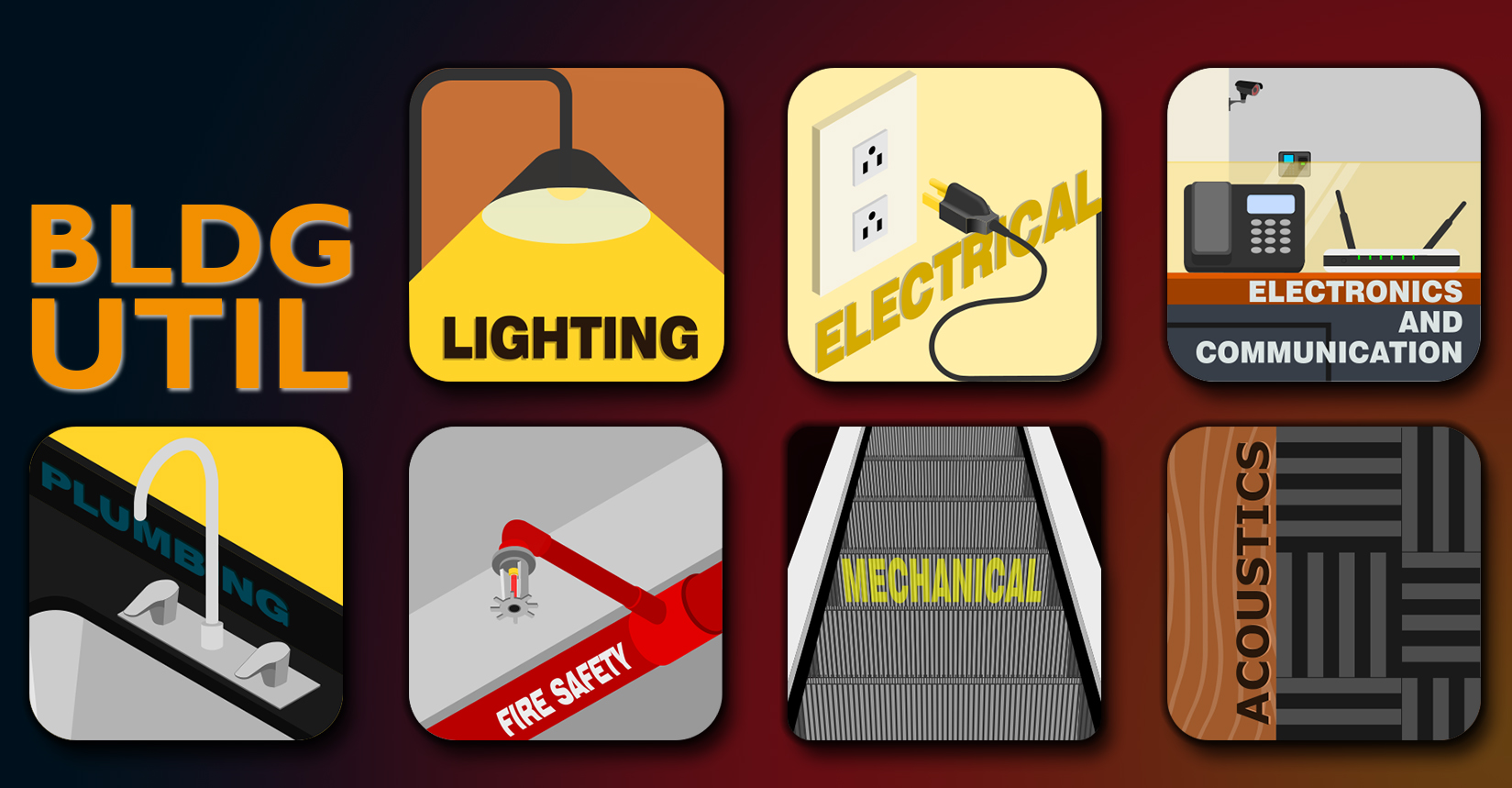
The course focuses on the environmental systems in buildings. Lecture discussions include building electrical systems, natural and artificial lighting, and building telecommunications.
Reducing operational loads and integrating high performance energy systems into buildings offers solutions towards achieving a sustainable and secure energy future. Engineers must understand the interrelationship between a building and its subsystems, and need sufficient knowledge of building systems and design alternatives to recommend appropriate solutions that suit the site, climate, building type, and occupants. They must coordinate the work of the engineering disciplines that carry the sustainability concept forward through building design, construction, commissioning, operation and, ultimately, demolition, recycling and reuse.
- Faculty: Ben Daniel N. Gamutan

This course deals with the concepts of the time value of money and equivalence; basic economy study
methods; decisions under certainty; decisions recognizing risk; and decisions admitting uncertainty.
- Faculty: Carolina M. Balmoria
The course covers the following topics; statics of particles: forces in plane, forces in space, equilibrium, moment of a force, moment of a couple, equivalent systems of forces on rigid bodies, equilibrium in two dimensions, equilibrium in three dimensions, distributed forces: centroids and center of gravity, analysis of structures: trusses, frames and machines, internal forces in beams and cables, friction, moments of inertia of areas, moments of inertia of masses.
- Faculty: John Allan A. Gulles
- Faculty: Beatriz Nicolle Oppus